
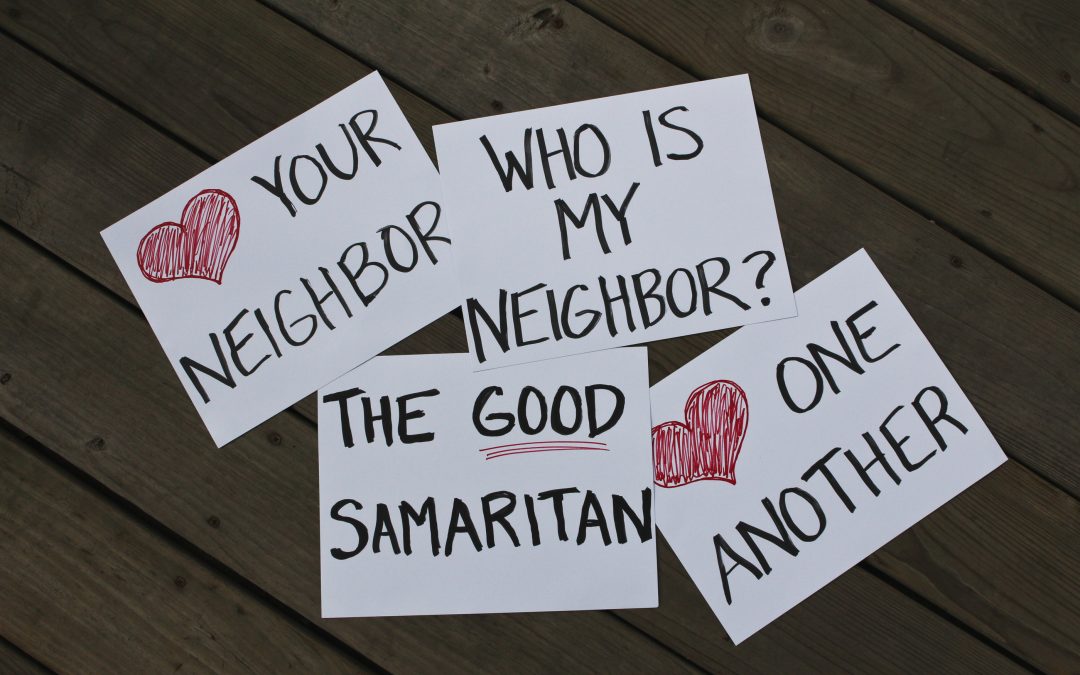
But a Samaritan, as he journeyed, came to where he was, and when he saw him, he had compassion. 34 He went to him and bound up his wounds, pouring on oil and wine. Then he set him on his own animal and brought him to an inn and took care of him. 35 And the next day he took out two denarii and gave them to the innkeeper, saying, ‘Take care of him, and whatever more you spend, I will repay you when I come back.’ 36 Which of these three, do you think, proved to be a neighbor to the man who fell among the robbers?” 37 He said, “The one who showed him mercy.” And Jesus said to him, “You go, and do likewise.” Luke 10:33–37
A lawyer stands up to test Jesus. And I want you to notice something — he asks the right question. "What must I do to inherit eternal life?" That's not a bad question. It's the question. Every human heart is asking some version of it, whether they use those words or not: How do I stand before God? What's enough?
Jesus turns it back on him: "What's written in the Law? How do you read it?" And the lawyer answers beautifully — he knows his catechism. "Love the Lord your God with all your heart, soul, strength, and mind, and love your neighbor as yourself." Jesus says, "You've answered correctly. Do this, and you will live."
Now — if the lawyer had stopped there, he would have walked away with the whole law and no way to keep it. But he doesn't stop. Luke tells us he wanted to justify himself. That phrase is doing a lot of work. He's not genuinely curious. He's looking for a legal loophole. So he asks: "And who is my neighbor?"
And Jesus tells a story.
I. The Road Is Real (vv. 30–32)
"A man was going down from Jerusalem to Jericho, and he fell among robbers, who stripped him and beat him and departed him half dead."
This is not hypothetical. Jesus places this story on a real road — the seventeen-mile stretch from Jerusalem down to Jericho. It was notorious. Travelers knew the risk. The terrain was rocky, the gorges were deep, and bandits hid in the crevices. This was not a safe commute.
So right away, Jesus is telling us something about the world we live in. The road is dangerous. People get hurt. And not always by accident — sometimes by violence, sometimes by neglect, sometimes by systems that leave them exposed.
The man is stripped, beaten, and left half dead. He has nothing left. No status, no money, no ability to help himself. He is, in every sense, at the mercy of whoever walks by.
That's the setup. And it's not just a first-century setup. It's ours. There are people on the roads of our lives — in our neighborhoods, in our workplaces, in our families — who have been beaten down by life, by loss, by addiction, by grief, by systems that failed them. They are lying in the road. The question is not whether they exist. The question is what we do when we see them.
II. The Religious Walk Past (vv. 31–32)
"Now by chance a priest was going down that road, and when he saw him he passed by on the other side. So likewise a Levite, when he came to the place and saw him, passed by on the other side."
Two people walk by. And Jesus is very deliberate about who they are. A priest. A Levite. Neither of them was a random stranger; rather, both were religious leaders. Having spent their lives serving in the temple and teaching others about God’s mercy and justice, they were precisely the people who should have known how to act.
And they see the man. Luke is careful to note that — they saw him. This wasn't a case of not noticing. They saw, and they chose to pass by on the other side.
Now, I want to be fair to them for a moment. There may have been reasons. The priest may have worried the man was dead, and touching a corpse would make him ritually unclean — he'd have to go through purification before he could serve again. The Levite may have had similar concerns. Maybe they were afraid the robbers were still nearby. Maybe they were in a hurry.
And here's what I want you to hear: there are always reasons. There are always good, sensible, even religious-sounding reasons to walk past someone in need. "I don't have time." "Someone else will step in." "Getting involved is too risky." "Lack of experience holds me back." "Protection has to come first." "My own burdens are already too heavy
The road from Jerusalem to Jericho is full of people with reasons.
But Jesus doesn't let the reasons off the hook. He names these two as men who saw and walked past. And the implication is clear: proximity to God's house does not guarantee a heart that looks like God's heart. You can know all the right theology and still walk on the wrong side of the road.
III. The Samaritan Stops (vv. 33–35)
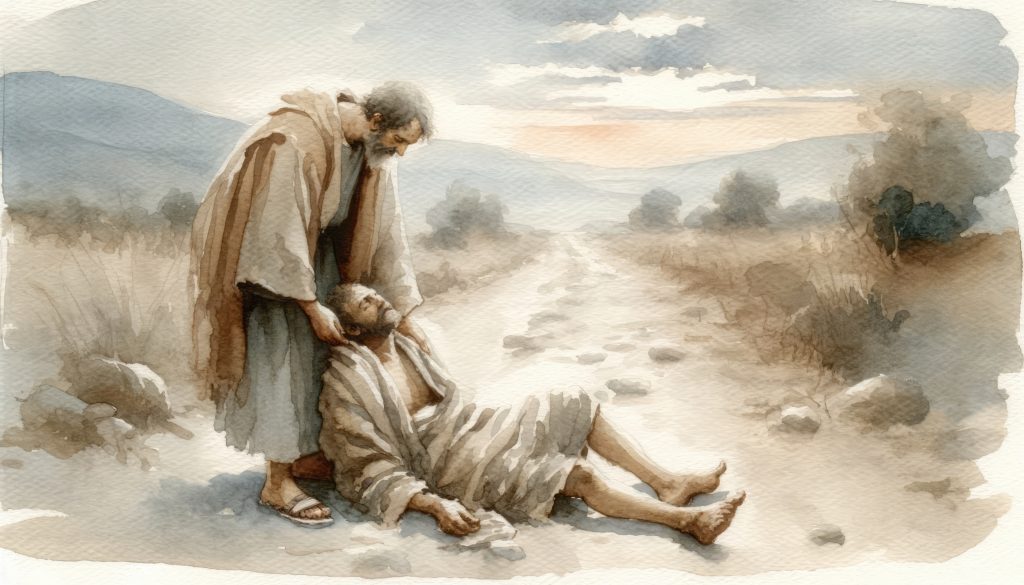
"But a Samaritan, as he journeyed, came to where he was, and when he saw him, he had compassion."
Now we come to the heart of the story. And we need to feel the shock of what Jesus is doing.
A Samaritan.
To the lawyer listening — to any Jewish person in the first century — this is the last person you'd expect to be the hero. Samaritans were despised. They were considered half-breeds, heretics, outsiders. Jews and Samaritans did not get along. They had centuries of hostility between them. If Jesus had asked the lawyer, "Who do you think is least likely to help?" the lawyer would have said, "A Samaritan."
And yet — this is the one who stops.
Gut-Level Compassion in Action
Luke says he had compassion. The Greek word is splanchnizomai — it's a gut-level word. It means his insides were moved. It's the same word used elsewhere in the Gospels for Jesus himself when he sees the crowds, when he sees the grieving, when he sees the lost. This is not pity from a distance. This is feeling someone else's pain in your own body.
Beyond a Favor: An Ongoing Commitment
And notice what he does. Approaching the man without hesitation, he treats his wounds with oil and wine—first-century first aid, but also an act of tenderness. He then places him on his own animal, brings him to an inn, and personally sees to his recovery. And then — he pays. Two denarii, two days' wages, and he tells the innkeeper, "Take care of him, and whatever more you spend, I will repay you when I come back."
This is not a quick favor. This is an ongoing commitment. The Samaritan doesn't just stop — he stays. He doesn't just help — he pays. He doesn't just feel compassion — he acts on it, and he puts his own resources on the line.
This is what mission looks like. Not a program. Not a project. A person, moved by compassion, stopping for another person, and being willing to pay the cost.
IV. The Question Reversed (vv. 36–37)
"Which of these three, do you think, proved to be a neighbor to the man who fell among the robbers?"
Now Jesus asks the question. But notice — he changes it. The lawyer asked, "Who is my neighbor?" as if to draw a boundary line. Jesus asks, "Which one proved to be a neighbor?" as if to say: the question is not about who qualifies for your love. The question is about what kind of person you are going to be.
The lawyer can't even say the word "Samaritan." He says, "The one who showed him mercy." And Jesus says, "Go and do likewise."
Now — here's where we need to be careful. If we turn this parable into nothing more than "be nice to people," we've missed it. If we turn it into a moral lesson — "try harder, do more, be better" — we've flattened the story.
The Gospel Picture Behind the Parable
Because here's the thing: every person in this story, except the Samaritan, is us.
We are the man in the road — beaten, broken, unable to save ourselves. We have been stripped by sin, left half dead by the brokenness of this world. And we could not help ourselves.
And Jesus — Jesus is the Good Samaritan. Coming right to where we lay, Christ looked upon us with deep compassion and bound up our wounds. He didn't just offer two denarii; instead, he paid the cost with his very life, ultimately carrying us to safety. And he is coming back.
That's the gospel. Before this parable is a command, it is a picture. It is a picture of what God has done for us in Christ.
And because of what he has done — because we have been found on the road and rescued — we now get up and walk differently. We stop for others. Not to earn God's love, but because we have already received it. Not to justify ourselves, but because we have already been justified.
V. The Mission Field Is Lying in the Road
So what does this mean for us? Let me give you three things to take home.
Three Action Steps for the Church Today
First: Mission starts with seeing. The priest and the Levite saw the man — but they didn't see him. They didn't see a person made in God's image. They saw a problem, a risk, an inconvenience. The Samaritan saw a person. Mission begins when we slow down enough to actually see the people around us — their pain, their need, their dignity.
Second: Mission requires proximity. The Samaritan was on the same road. Rather than sending help from a distance, he got close enough to touch the wounds and carry the weight himself. If we want to be on mission, we have to be willing to get close to people who are hurting — and that's messy, and it's costly, and it takes time.
Third: Mission is rooted in mercy, not merit. The Samaritan didn't help because the man deserved it. He helped because compassion moved him. And our mission flows from the same place — not from guilt, not from obligation, not from a desire to look good, but from the mercy we have received from Christ. We love because he first loved us.
Closing
The lawyer wanted to draw a line. He wanted to know: who's in, who's out, who counts as my neighbor, and who doesn't?
Jesus erased the line.
Your neighbor is whoever is lying in your road. Your mission field is wherever God has placed you. And the power to stop, to see, to serve, to pay the cost — that power comes from the One who stopped for you.
He saw you. Jesus had compassion. Our Savior paid the price. And he's coming back.
Go and do likewise.
Let's pray.
Father, we confess that we have walked past. We have seen the need and kept going. Time and again, we offer excuses while drawing narrow lines around who we choose to love. Forgive us. Thank you for the mercy you have shown us in Christ — that when we were lying in the road, you did not pass by. Lord you came to us. You bound our wounds. You paid the cost. Now send us out — not in our own strength, but in yours. Open our eyes. Soften our hearts. Give us the courage to stop. For the sake of Jesus, who first stopped for us. Amen.