A pastoral word for Election Day
The Big Idea
As God rules both the church and the state a Christian can vote with a clear conscience. Not as a saviour, not as a spectator but as a neighbour.
The Text and Its Context
Matthew 22:15–22 — the question about paying taxes to Caesar. The Pharisees and Herodians come at Jesus with a trap disguised as a compliment: "Is it lawful to pay taxes to Caesar, or not?" If He says yes, He loses the crowd that hates Rome. If He says no, He's a rebel, and Rome deals with Him. He asks for a coin, points to the image and inscription, and answers: "Therefore render to Caesar the things that are Caesar's, and to God the things that are God's."
That one sentence is the root of Luther's two kingdoms teaching. What does Jesus do? Rather than telling his followers to pull back from the world or giving Caesar a blank cheque, he holds together two things which we are so constantly tempted to split asunder. And he does it in such a way that the crowd is left in awe and the trap is completely empty.
Introduction
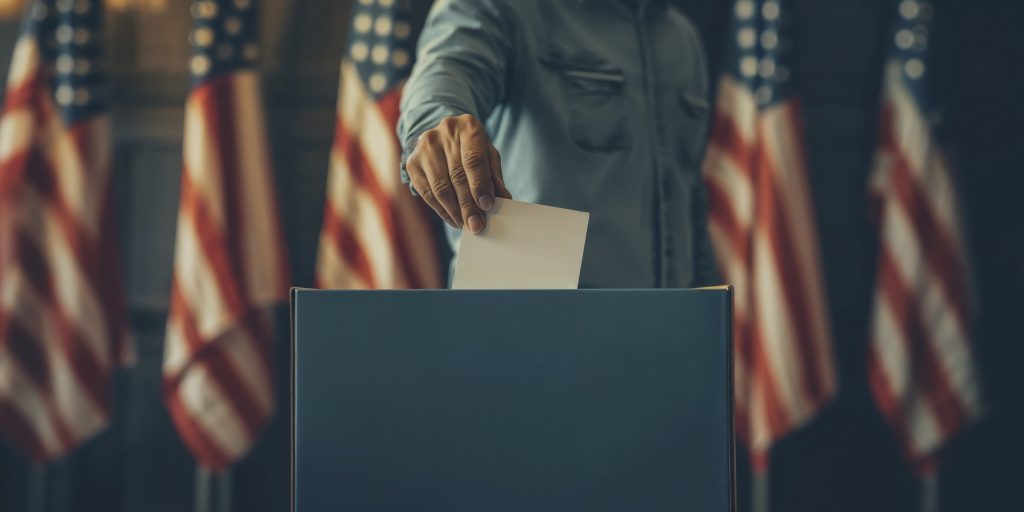
Tomorrow the polls open.
We'll all be walking away with something heavier than a ballot really. Some of us will be voting with a knot in our stomach, half-afraid of what will happen if our side loses. Some of us are just quietly tempted to walk away altogether, to tell ourselves that politics is all dirty and the Christian's real business is in the spiritual realm so why on earth should we get involved? And then there are a whole host of us who have, without ever saying it, begun to put a great deal of hope on a candidate or a party that they were never meant to carry.
Have you been there? Can you relate?
So before you're standing in that line tomorrow, let's take a moment to consider what God's Word actually teaches us about how a Christian is to engage the public square. Not a party platform. Not a soundbite. A framework. A framework that's been the church's framework for five hundred years and one that actually protects us from two very different errors at the same time.
For Further study Luther's Doctrine of the Two Kingdoms on the Journal of Lutheran Ethics
1. How the Two Kingdoms Shape Our Lives
Here's the basic distinction.
God rules His world in two ways. In the church (which we might refer to as the kingdom of the right hand) He works through the Word and the Sacraments to save sinners. That is where the gospel is preached, where sins are forgiven and where the Holy Spirit creates faith. In the state (the kingdom of the left hand) He works through laws, courts and yes the sword to suppress wickedness and to enable the common man to live in peace.
Both are His. Both are good gifts. And the bit we tend to forget is that the person sitting in the governor's chair or the school board chair is not holding an office outside of God's rule. They are holding an office *within* it. When Paul writes to the Romans that the governing authority "is God's servant for your good" he's talking about a pagan empire and he still calls it God's servant.
So first of all: you don't withdraw. Active participation in public life has been a feature of the Lutheran movement from the very beginning. Encouraging Christians to vote is not violate the two kingdoms teaching as God calls His people to be salt and light and salt and light aren't abstract things. They are manifested in the neighborhood, in the school, at the ballot box for the good of the neighbor.
But secondly and just as importantly: you don't confuse the kingdoms. The doctrine is not that Christians abandon their consciences. It is that they participate in the secular realm in a lawful way, obeying authority and using the means of the state to promote what they understand to be good, as they understand good through the lens of their faith. Your faith will shape the way you see the world. It doesn't turn a polling station into a baptismal font.
2. What a Vote Can and Cannot Do
Right then, let's be absolutely honest about what we're actually going to be doing tomorrow.
Officeholders aren't pastors. We're not electing bishops. We're electing people to run a government. People to write the budget, to set policy, to administer the law. The left hand kingdom is a kingdom of law, of reason and of justice. Competence and fairness are the things that matter. A non-Christian can be a good governor and a Christian can be a bad governor. That shouldn't scandalise us. That should be the very thing that makes it clear what we're actually assessing.
At the same time — this is the point that keeps us honest — faith will determine how you go about doing the job. The deepest convictions you have about human dignity, about the poor, about the family, about what a human being is — those convictions don't go away when you take the oath. You can't neatly separate faith from public life. You're not choosing between a religious and a secular candidate. You're choosing between two complete human beings, each of whom will be governing from whatever is in their heart.
And here's the guardrail that keeps us from the most fundamental error of all: politics is not the gospel.
Neither party is the kingdom of God. No platform is the Great Commission. A vote is not a confession of faith and a ballot is not a creed. That one truth is the safeguard against two very different spiritual illnesses: messianic hope in a candidate and the despair of a loss. If your candidate wins tomorrow the kingdom hasn't come. If your candidate loses the kingdom hasn't gone. Christ's throne is not on the ballot and that is excellent news.
3. Vote as Service to Your Neighbor
So what is a vote?
It's a work of vocation. It's one way (a fairly small, unassuming, once-a-year way) of loving and serving the people around you, including the vulnerable who can't speak up for themselves.
That completely reorients the whole thing. If voting is a matter of service then the question is no longer "Which candidate most reflects me?" but "Which candidate most serves my neighbour?" (the poor, the unborn, the immigrant looking for a chance, the elderly, the child in the failing school, the family who are just trying to make rent). That's a tougher question. It's also a better one.
You can vote with a clear conscience even if you're not absolutely thrilled with the outcome. You're not looking for a saviour. You're looking for a servant and you're going to be one.
Where Faithful Lutherans Disagree
A word of honesty actually, because I'd be a very poor pastor if I were to pretend that this framework gives you a voting guide.
It doesn't. It's a framework and faithful Christians will of course draw different conclusions from it.
Some will be very much in the moral camp and will be urging Christians to use their vote as a witness to Christian morality and values. Others will be very much in the camp of humility and will be saying that the doctrine should make us humble about our claim to any divine endorsement of a particular platform or party. Both of those have a real basis. Both of those can go wrong too (the first when it becomes triumphalism and the second when it becomes indifference).
I won't go so far as to tell you how God wants you to vote. The church only speaks on political matters in very limited circumstances and the most obvious of those is when the state itself is doing something contrary to Christ. In that case we obey God rather than men and no doctrinal framework is going to get us out of that. On the normal questions of an ordinary election however you are a free conscience before God and He has given you His Word, His Spirit and His people to help you to think.
Four Questions to Carry Into the Booth
- What does each office actually do? What can this candidate possibly do about the issues that matter to me? A great deal of our political anxiety is actually based on the notion that an office is supposed to do things which it was never actually given the power to do.
- Am I weighing the good of my neighbors, or mostly my own interests? This is the vocational question. It is also the most searching one.
- Am I treating political opponents truthfully? Luther's explanation of the Eighth Commandment still applies in campaign season. We are not permitted to bear false witness against a neighbor just because he wears the other jersey or plays for the other team.
- Could I vote with a clear conscience and still hold my hope in Christ, not in the outcome? If your peace tomorrow night depends on the returns, your peace is in the wrong place.
The Gospel Connection
Here's why a Christian can get involved in politics without it consuming them.
The real problem in the world isn't a policy problem. It's a sin problem. And that sin problem has already been solved (not by a candidate, but by a cross). Jesus Christ, God and man, kept the Law which we could not keep and died in our place as the atoning sacrifice for our sins. He rose again and conquered death and Satan. And He did all of that whilst we were still sinners, whilst we were still His enemies, whilst we had nothing to offer Him.
That's the kingdom which cannot be voted out.
So you can go and vote tomorrow as a citizen of this country. Whether you win or lose an election, you can do so without losing your hope or falling into arrogance. After all, you can genuinely care about your country because you ultimately care about a kingdom that is not of this world—and that is what enables you to love your neighbour here without requiring this world to be your heaven.
Conclusion: Power Down, Then Power Through
You might have a very high pain tolerance when it comes to politics. A lot of us do. We can take the anger, the outrage, the sheer volume of it, the sheer amount of scrolling and the resulting knot in the stomach and still tell ourselves we're being responsible.
You need physical rest and spiritual rest. Tomorrow before you do anything else, power down. Admit to God that you can't save this country and that you were never asked to. Admit the ways in which you have looked to politics for what only Christ can give. Then power through in the strength that you have, not in your own strength but in the strength of the One who has already won the only victory that really counts.
As a citizen of two kingdoms, cast your vote. Let it be an act of service to your neighbor. Above all, vote as someone whose hope is not on the ballot.
There you will find your peace not in the result but in the One who holds all results in His hands.
And remember whatever the returns say on Tuesday night: you matter to God.
About the Author Rev. Dr. Keith Haney is an author, podcast host, leadership consultant, and executive director specializing in organizational management and leadership development. As the host of Becoming Bridge Builders and the author of Guided by Grace: A Narrative to Lead Organizational Change, he helps leaders navigate complex cultural and organizational transitions with wisdom, courage, and faith.