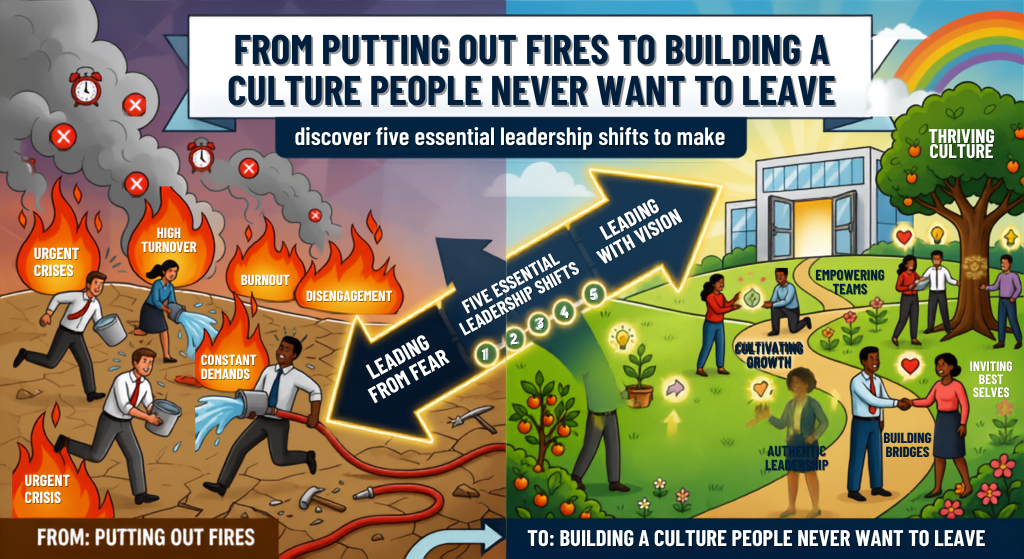
If you’re like most leaders I know, you’re not short on effort. You’re showing up early, staying late, and pouring yourself into every challenge. But I’ve noticed that so much of that energy gets spent putting out fires instead of building the bridges that help our teams thrive.
When someone leaves the team, it’s easy to slip into panic mode. We scramble to patch things up, offer quick perks, and treat every resignation like a crisis. But reacting to the symptoms doesn’t heal what’s underneath. If we want our teams to truly thrive, we have to move beyond managing for output and start caring for people in ways that invite their best selves to the table.
To build a culture where your best people choose to stay—and build the future alongside you—here are five essential leadership shifts to make:
1. Emotional Regulation: Dismantle the Bunker
When someone you count on decides to move on, it stings. I’ve been there. The temptation is to pull back, to protect your heart by lowering your expectations or holding your team at arm’s length. But that quiet caution can build walls where bridges are needed most.
The metaphor to remember: Don't build a fortress to shield against ghost-ship memories.
If we lead from a place of fear, we end up punishing those who stay for the choices of those who left. What our teams need is not our armor, but our open doors and our full presence.
Key Takeaway: Never let the person who left dictate how you treat the people who stayed.
2. Delegation: Hand Over the Keys to the Best Assignments
It’s natural to want to hold on to the projects that matter most. They feel safe, familiar. But if we never let others take the wheel, we rob them of the chance to discover what they’re truly capable of.
The metaphor to remember: You can’t build bridges if you refuse to let go of the blueprints.
Letting go of your favorite assignment isn’t about losing control. It’s about showing your team you trust them, even if things get a little messy along the way.
3. Transparency: Strip Away the Polish
People can spot empty words a mile away. The best folks on your team don’t want polished slogans or canned speeches. They want to be part of something real, something they can help shape.
The metaphor to remember: Hand them a paintbrush, not just a framed picture.

When you sit down one-on-one, let the mask drop. Invite your team into the real conversation about where you’re headed and how their gifts can help shape that future.
Key Takeaway: If you do not paint a clear picture of their future with you, they will eventually paint one without you.
4. Meeting Execution: Perform a Table Audit
If every meeting ends with polite nods and no real conversation, it’s a sign something’s missing. Real alignment isn’t about everyone agreeing; it’s about making space for honest voices, even when it’s uncomfortable.
The metaphor to remember: Quiet waters aren't always calm—sometimes they are stagnant.
Audit your table. Are you listening only to the loudest instruments, or are you creating space for the full orchestra? Actively solicit the quiet, contrarian, or complex voices. True alignment isn't born from forced silence; it’s forged through constructive friction.
5. Coaching: Cultivate a Greenhouse, Not a Holding Cell
If being on your team feels like standing still, your best people will eventually look for somewhere else to grow. Our job as leaders is to help raise the ceiling so high that staying means growing into more of who they’re meant to be.
The metaphor to remember: Be the launchpad, not the lid.
Focus relentlessly on the growth factor. Pour into your team so deeply that their capacity continually expands. Your ultimate goal isn't just retaining talent—it's leaving every person who crosses your path more capable, more confident, and more authentically themselves than the day you met them.
Over to You
Which of these five shifts represents the biggest bridge you need to build in your leadership right now? Drop your thoughts in the comments below!
Dr. Keith Haney is an author, podcast host, and executive leader specializing in organizational management, leadership development, and strategic communication. As the host of the Becoming Bridge Builders podcast and author of Guided by Grace: A Narrative to Lead Organizational Change, he equips leaders with practical frameworks for navigating complex transitions, improving decision clarity, and fostering meaningful connections in high-stakes environments.