Churches rarely lack programs, inspiring sermons, or good intentions. What they lack is a repeatable, sustainable framework to bridge the gap between Sunday inspiration and Monday transformation.
Welcome to the Becoming Bridge Builders series on discipleship—a comprehensive four-pillar framework designed to equip pastors, elders, ministry leaders, and emerging voices to build a multiplying discipleship culture.
How to Use This Leadership Training
This framework consists of four 60–90 minute sessions (one per pillar) using a consistent 5-step format:
- Opening Question: A single prompt to surface assumptions and spark honest conversation.
- The Problem: The cultural or relational tension leaders are navigating right now.
- The Shift: The core mindset or practice change required.
- The Practice: Concrete, actionable steps your team can take this week.
- Discussion & Commitment: Guided reflection and a written next step.
- Who It’s For: Small group leaders, ministry team leads, elders, staff, and emerging leaders.
- What You Need: A facilitator, a room, Bibles, and a commitment to honest evaluation.
Pillar 1: From Crowds to Tables
Opening Question
“Think about the person who has had the greatest spiritual impact on your life. Was that relationship built on a program—or proximity?”
The Problem
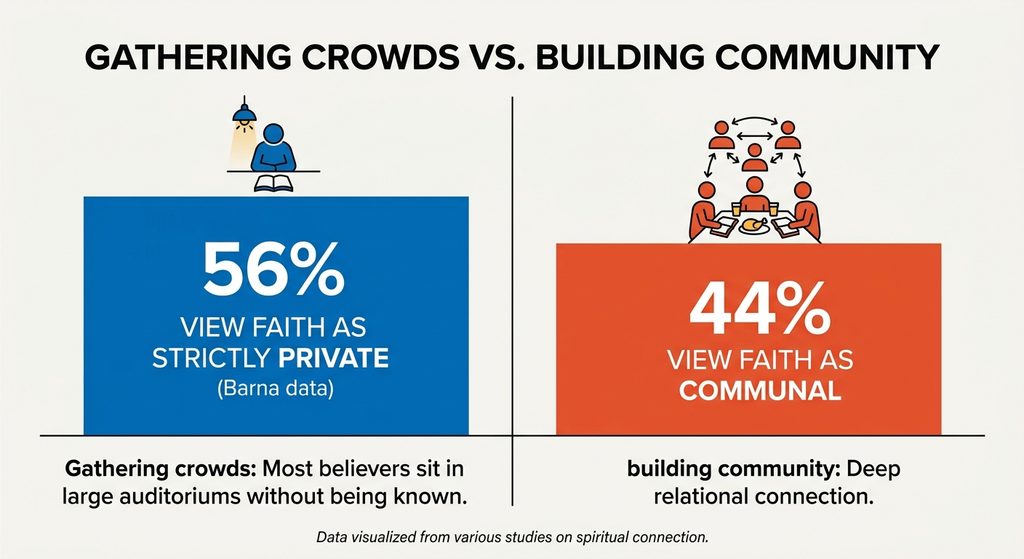
Most churches excel at crowds but struggle with connection. Sunday inspiration fades by Monday because it lacks relational proximity. Beyond general isolation, churches face a quiet generational fracture: older saints carry decades of wisdom but lack a platform, while younger believers have energy and hunger for authenticity yet often end up discipled by YouTube.
The Shift
Shift from programming relationships to cultivating them. Deep spiritual formation happens in groups of 3–5 where no one can hide. Jesus prioritized the three (Peter, James, and John), and Paul walked directly alongside Timothy.
“And let us consider how to stir up one another to love and good works, not neglecting to meet together, as is the habit of some, but encouraging one another.” — Hebrews 10:24–25
The Practice
- Launch Covenant Micro-Groups: Form closed groups of 3–5 meeting weekly or biweekly. Use simple accountability questions: Where are you struggling? What does faithfulness look like this week?
- Build Intergenerational Pairings: Connect spiritually mature older members with younger believers for a simple monthly rhythm (a meal or a walk). Focus on presence over productivity.
- Equip Shepherds, Not Facilitators: Train leaders to ask questions, listen deeply, and offer midweek care rather than just teaching content.
Discussion Questions
- What currently fills the relational gap in your ministry—programs or people?
- Who are the older saints in your church who carry wisdom but have no platform to share it?
- If you launched a micro-group tomorrow, who would be in it?
- Commitment: Write down one micro-group or intergenerational pairing you will initiate by a specific date.
Pillar 2: Digital Integration

Opening Question
“How many hours did you spend on your phone this week—and how many of those hours moved you closer to Christ?”
The Problem
With the average person checking their phone 96 times a day, digital algorithms disciple your congregation constantly. Churches often err by either ceding the week to screen time or over-correcting into digital avoidance. Your people don’t need more content noise; they need high-trust formation integrated into their Tuesday commute or evening routine.
The Shift
Move from digital avoidance or dependence to digital discernment. Technology is not neutral but can serve as a bridge between Sunday gatherings and midweek life.
“Look carefully then how you walk, not as unwise but as wise, making the best use of the time, because the days are evil.” — Ephesians 5:15–16
The Practice
- Build Hybrid Rhythms: Send a consistent short midweek touchpoint like a 3-minute voice reflection, a micro-group text prompt, or a family dinner question.
- Teach Digital Discernment: Host quarterly sessions on how algorithms shape beliefs, managing screen habits, and practicing digital fasts without legalism.
- Equip Households: Give parents concrete tools and conversation starters to shape their family’s digital habits rather than just monitoring screen time.
Discussion Questions
- What digital habits in your congregation concern you most? What habits give you hope?
- If your church disappeared from the internet tomorrow, would your people notice midweek?
- What is one simple digital touchpoint you can launch this month?
- Commitment: Commit to launching one consistent midweek digital touchpoint by a targeted date.
Pillar 3: Whole-Life Stewardship
Opening Question
“If someone followed you from Sunday morning to Friday afternoon—watched how you work, spend money, handle conflict, and treat your family—would they see the same faith you preach on the weekend?”
The Problem
Churches face a quiet crisis: people who are theologically informed but practically unchanged. Believers know what to believe, but faith remains compartmentalized from workplace choices, finances, mental health, and family dynamics. Sunday faith and Monday life exist in separate compartments, creating busy volunteers who remain spiritually stagnant at home.
The Shift
Move from compartmentalized faith to integrated stewardship. Stewardship is the faithful management of everything God has entrusted to you: time, influence, work, mental health, and relationships. Every arena of life becomes space for worship.
“Whatever you do, work heartily, as for the Lord and not for men.” — Colossians 3:23
The Practice
- Teach the “Monday Examen”: Train people to end their workday by asking two 5-minute questions: Where did I see God at work today? Where did I fail to represent Christ, and what would faithfulness have looked like?
- Preach on Everyday Struggle Areas: Directly address topics like workplace ethics, financial generosity, marriage communication, burnout, and addiction from the pulpit.
- Create “Faith at Work” Groups: Gather members by vocation or life stage (e.g., teachers, entrepreneurs, parents) to discuss what context-specific obedience looks like.
Discussion Questions
- What’s the biggest gap between what your people profess on Sunday and how they live on Monday?
- Which area of whole-life stewardship does your church currently address well? Which are you avoiding?
- What would change if your people started seeing their work and relationships as arenas for worship?
- Commitment: Address one “Monday life” topic from the pulpit or in a group setting that you have previously avoided.
Pillar 4: Everyday Missional Living
Opening Question
“When you think about the mission of the church, do you picture people coming in—or going out?”
The Problem
Many churches treat the building as the center of gravity, measuring success strictly by attendance. This attractional model inadvertently produces church consumers rather than sent missionaries. The New Testament shows a church that gathers to be equipped and scatters to be on mission in everyday spaces.
The Shift
Move from an attractional mindset to a sent mindset. The Sunday gathering is not the final destination. It is the launchpad. The true measure of church health is how many believers actively represent Christ on Monday in places only they can reach.
“As the Father has sent me, even so I am sending you.” — John 20:21
The Practice
- Reframe Membership Language: Shift from defining members as people who “belong to an institution” to people who are “sent from a base.”
- Commission Everyday Missionaries: Regularly commission members for their specific daily spheres—parents, business owners, teachers, and retirees.
- Embed Missional Rhythms in Groups: Require small groups to adopt a local need (a school, neighborhood, or non-profit) so spiritual formation flows into outward service.
- Celebrate Sent Stories: Consistently share ordinary testimonies of Tuesday-morning faithfulness from the stage and in church communications.
Discussion Questions
- If “sent” became the primary identity of your congregation, what would have to change in your programming and metrics?
- Who in your church is already living missionally in their everyday context?
- What is one “sent” practice you could embed into an existing structure this month?
- Commitment: Publicly commission or celebrate one person or group for their everyday mission outside the church walls by a set date.
Building a Culture, Not Just a Program
These four pillars—Tables, Digital, Stewardship, and Sent—form a single integrated vision for a discipleship culture where people are known deeply, formed weekly, equipped for all of life, and sent as everyday ambassadors.
Transformation won’t happen through a single program launch. It happens as leaders commit to the long-term work of cultivating people over managing programs.
Start with one pillar. Start with one group. Build the bridge.
Dr. Keith Haney is an author, podcast host, and executive leader specializing in organizational management, leadership development, and strategic communication. As the host of the Becoming Bridge Builders podcast and author of Guided by Grace: A Narrative to Lead Organizational Change, he equips leaders with practical frameworks for navigating complex transitions, improving decision clarity, and fostering meaningful connections in high-stakes environments.